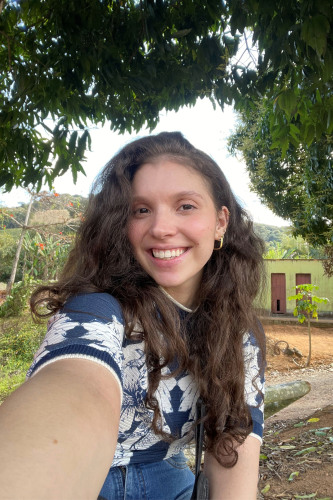
Rafaela Carvalhinho
Biography
Education Background
M.A. in Arts, Literature, and Languages — French and Comparative Literature Nantes Université – Nantes, France
B.A. in Portuguese Language and Literature Federal University of Espírito Santo (UFES), Brazil
Biography
Rafaela Carvalhinho's research focuses on contemporary Brazilian and Lusophone literatures, particularly marginalized narratives and their intersections with politics, social justice, memory, and resistance. She holds a master’s degree from the University of Nantes, France, where she studied women’s writing through the works of Annie Ernaux, Clarice Lispector, and Lydia Davis. Her undergraduate thesis examined the translation of Jane Austen’s “Ode to Pity” into Portuguese, with a focus on stylistic and cultural nuances. Before joining Brown, she taught Portuguese to immigrants and refugees from French-speaking African countries through the Releitores University Extension Project, preparing students for the CELPE-Bras proficiency examination. Her broader interests include literary translation and the circulation of Brazilian and Lusophone literature across languages and borders.
Teaching
English teacher 2025
Cultura Inglesa – Vitoria, Brazil
- Taught English across beginner to advanced levels, emphasizing language as a vehicle of culture and identity formation, and integrating comparative literary excerpts to stimulate cross-linguistic interpretation and critical reading.
- Designed and implemented context-based curricula balancing grammar, semantics, and discourse analysis to strengthen students’ understanding of language as system and medium of thought.
- Guided advanced learners in academic writing, stylistic analysis, and rhetorical precision, encouraging reflection on the relationship between language, power, and expression.
- Assessed student progress through analytical feedback and reflective writing exercises, fostering intellectual autonomy and metalinguistic awareness.
Intern — Literatura Teaching 2021 – 2022
Federal Institute of Espirito Santo – Vitoria, Brazil
- Designed and taught a semester-long introductory literature course for secondary-level students, integrating Brazilian literary movements (Realism and Naturalism) with critical and creative approaches to reading.
- Developed innovative pedagogical methods, including a literature-based interactive game, to foster interpretive engagement and introduce concepts of narrative, form, and authorship in accessible ways.
- Composed reflective analytical reports examining how interactive pedagogy impacts students’ reception of literary texts, bridging reader-response theory and classroom practice.
- Demonstrated the transformative potential of literature as a democratic tool for cultural participation, connecting literary analysis to questions of representation, access, and interpretive agency.
- Collaborated with faculty mentors to evaluate curricular effectiveness, contributing insights that informed discussions on national literature teaching standards and pedagogical innovation.
Portuguese Teacher — Portuguese-language Teaching 2019 – 2021
Federal University of Espirito Santo – Vitoria, Brazil
- Taught Portuguese as a second language to francophone immigrants preparing for the Celpe-Bras exam, implementing communicative and interpretation-based approaches to develop fluency, cultural understanding, and exam-specific competencies.
- Delivered Portuguese language and writing instruction to public high school students from under-resourced backgrounds preparing for the ENEM, focusing on reading comprehension, argumentative essay structure, and critical interpretation of multimodal texts.
- Developed instructional strategies that linked grammar, discourse analysis, and real-world communication, supporting both academic writing and functional language use.
- Conducted reflective teaching assessments to evaluate how interactive and student-centered methodologies affected learning outcomes, classroom participation, and confidence in exam settings.
- Promoted language learning as an accessible cultural and social tool, emphasizing representation, identity, and agency in literacy development for multilingual and socioeconomically diverse learners.